

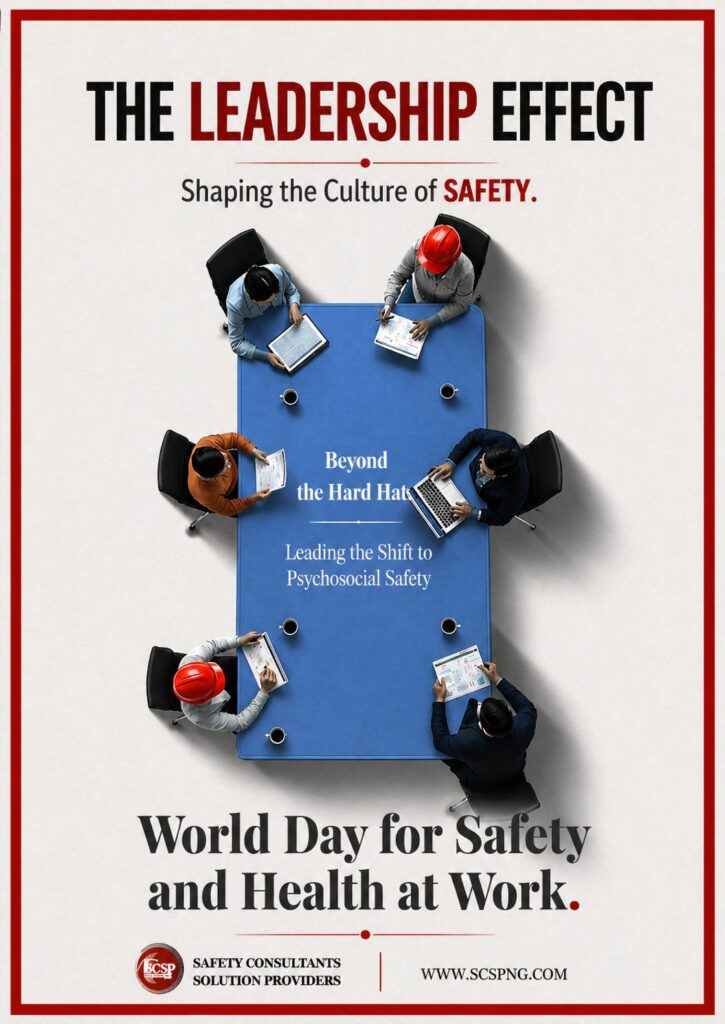
On this World Day for Safety and Health at Work 2026, we find ourselves at a critical crossroads. In 2025 alone, Nigeria witnessed a staggering ₦74.75 billion loss to fire incidents, while industrial outbreaks in Lagos claimed 133 lives and drained ₦19 billion from our economy. For leaders in oil, gas, manufacturing, and power, these figures represent a severe hemorrhage of capital and a direct threat to the continuity of our operations.
While a refinery fire or a construction collapse is a visible catastrophe, the global focus for 2026 compels us to look deeper. The root of these failures is rarely found in the machinery alone; it is found in the psycho-social working environment.
As workloads intensify and technologies like AI-driven production reshape our shop floors, the mental and social strain on workers has reached a peak.
We must recognize that when the psycho-social environment is neglected, the likelihood of a bypassed safety barrier or a catastrophic "miss" in a HAZOP increases exponentially.
The invisible Control System
Psycho-social safety is the invisible control system of every organization. It describes how culture, leadership behavior, and social dynamics influence safety outcomes at the point of work. In modern industry, it is widely observed that 60% to 80% of workplace accidents have a contributing behavioral or organizational factor.
Whether it is a supervision gap or unsafe decision-making under pressure, safety performance is ultimately a reflection of how an organization behaves when the pressure is on.
This behavior is shaped by the tension between "designed safety" and "operational reality." In many industrial systems, less than 60% of written procedures are fully executable in real field conditions. This gap creates a dangerous environment where workers naturally adapt to meet production targets.
When deadlines override safety systems, shortcuts become normalized. Studies reveal a sobering reality: less than 40% of workers in high-risk environments feel safe reporting hazards without fear of reprisal. This silence is the earliest warning signal of an impending system failure.
From Compliance to Strategic resilience
There is now a clear divide in West African industry between reactive and strategic organizations. Reactive organizations respond to incidents after the damage is done, absorbing production losses and facing regulatory shutdowns.
Conversely, strategic organizations those managing our region's mega-projects treat safety as a core driver of investment protection. They do not view safety as a reactive compliance box to check; they design risk out from the outset.
Strategic resilience requires a shift toward Human Factor Engineering (HFE) and sophisticated Root Cause Analysis (RCA). True safety is not achieved by identifying what happened, but by uncovering the why behind the human decision.
At Safety Consultants & Solution Provider (SCSP), we move beyond the surface of "human error" to investigate the systemic pressures be it production timelines or leadership gaps that made a deviation seem like a logical choice at the time.
A Call to Leadership
As employers and executives, you are the architects of this culture. You must recognize that culture is defined by what you tolerate, not what you publish. If leadership tolerance of minor deviations exists, incident recurrence rates can be up to three times higher.
Sustainable safety excellence is not found in the absence of rules, but in the consistent, lived enforcement of those rules under real workplace conditions.
In today’s capital-intensive environment, operational disruptions are no longer absorbable risks; they are business-critical threats. To honor this World Day for Safety, we must commit to replacing the frantic culture of "firefighting" with a steady, engineered rhythm where safety is a predictable driver of the bottom line.
By aligning leadership behavior with execution discipline, we can transform safety from a variable into a constant. SCSP is ready to partner with you through specialized Process Hazard Analysis (PHA), Human Factor Engineering, and deep-dive Root Cause investigations to ensure your next board report shows stabilized uptime and a measurable drop in human-error risks.
Learn more about our Workplace & Safety Solutions for industrial organizations operating in high-risk environments.
Antonia Beri
Technical & Process Safety Expert Founder/CEO,