

How do I conduct a fire risk assessment for my business in Nigeria? It is one of the most important questions any business owner or safety officer can ask, and the answer starts well before any inspector arrives at your door. Most fire incidents in Nigerian commercial premises do not happen out of nowhere. They happen because a frayed cable was ignored, an exit corridor became a storage room, or a fire extinguisher was last serviced in a year nobody can remember. The conditions exist long before the fire does. A fire risk assessment is the structured process that surfaces those conditions, gives you a prioritized list of what to fix, and creates the documented evidence that your business is being managed responsibly.
This is not simply a regulatory exercise, though it satisfies regulatory requirements. It is the clearest picture you can get of what could go wrong inside your building and what stands between your staff, customers, and assets and a catastrophic outcome. The eight-step process below is built around Nigeria’s fire safety regulations and NFPA standards. For straightforward commercial premises, a shop, an office, or a small warehouse, any diligent business owner or safety officer can work through it directly. For larger, higher-risk, or more complex facilities such as industrial plants, high-rise towers, or large warehouses, engaging a qualified fire safety specialist is the more prudent course. Either way, understanding each step puts you in control of the process. For specially tall buildings, see our guidance on structural integrity considerations against collapse in case of fire.
If you need a qualified assessor to conduct or validate the assessment for licensing, insurance, or regulatory purposes, contact Safety Consultants & Solution Providers Limited (SCSP) to arrange a walk-through.
What Nigerian fire safety law actually requires from your business
Three layers of law govern fire safety in Nigerian commercial premises. The Fire Service Act is the principal federal statute, empowering fire services to prevent, control, and extinguish fires and protect life and property. The National Fire Safety Code (2013) sets the minimum technical standards: automatic fire detection in all business-use buildings, manual call points at every floor corridor (no more than 30 metres travel to reach one), adequate escape routes, extinguishers, emergency lighting, and rising mains for taller buildings. The Factories Act adds occupational safety duties for workplaces, including fire prevention and evacuation procedures. For wider context on workplace obligations, read about the need for occupational safety and health in the workplace.
States add their own layer. Many states, Lagos being the most prominent example, have enacted their own fire service legislation that operates alongside the federal framework. A business in Lagos, for instance, must satisfy both the National Fire Safety Code and Lagos State fire service rules simultaneously. This dual compliance obligation is exactly where gaps most commonly appear, particularly for businesses that relocate, expand into new floors, or change their use without reassessing their fire safety position. If you operate in other states, verify whether local fire service legislation applies to your premises.
Enforcement comes from the Federal Fire Service, state fire services, and Ministry of Labour factory inspectors. An inspection failure can trigger a correction order, a formal enforcement notice, a prohibition order closing the premises, or prosecution leading to fines and imprisonment. The cost of non-compliance vastly exceeds the cost of getting it right the first time.
How do I conduct a fire risk assessment for my business in Nigeria, the 8-step process
Steps 1 and 2: Identifying hazards and the people most at risk
How to walk your premises and spot fire hazards
Start with a physical walk-through of every zone in the building, not just the main trading floor or production area. You are looking for three things: ignition sources, fuel sources, and anything that would help a fire spread. Electrical faults and overloaded circuits are the most prevalent cause of commercial building fires in Nigeria, so check distribution boards, extension leads, and wiring conditions carefully. Fuel sources include paper, cardboard, waste accumulations, and flammable liquids; poor housekeeping alone is a significant contributor. Ignition sources include cooking equipment, heating appliances, generators, and any hot-works activity.
Mapping everyone who could be harmed
List every category of person who uses or enters the premises: staff, customers, visitors, contractors, and delivery personnel. Then go further and identify individuals whose evacuation needs differ from the general population. People with mobility impairments, vision or hearing loss, lone workers on night shifts, and pregnant employees all require specific provisions in the evacuation plan you will build later. Recording these individuals at the hazard-identification stage means their needs are built into the solution, not added as an afterthought.
Steps 3 and 4: Evaluating the risk and putting controls in place
How to decide how serious each hazard really is
Risk evaluation combines two factors: how likely a fire is to start, and what the consequences would be for the people in the building. An unguarded electrical distribution board situated next to a paper store in a busy open-plan office scores high on both counts. A designated outdoor smoking area with a covered metal bin and clear separation from the building is considerably lower. The output of this step is a prioritized action list. Address the highest-likelihood, highest-consequence hazards first and work down from there.
The controls that matter most in Nigerian commercial premises
Five controls resolve the majority of fire risk in commercial buildings and are bench-marked in both the National Fire Safety Code 2013 and NFPA guidance:
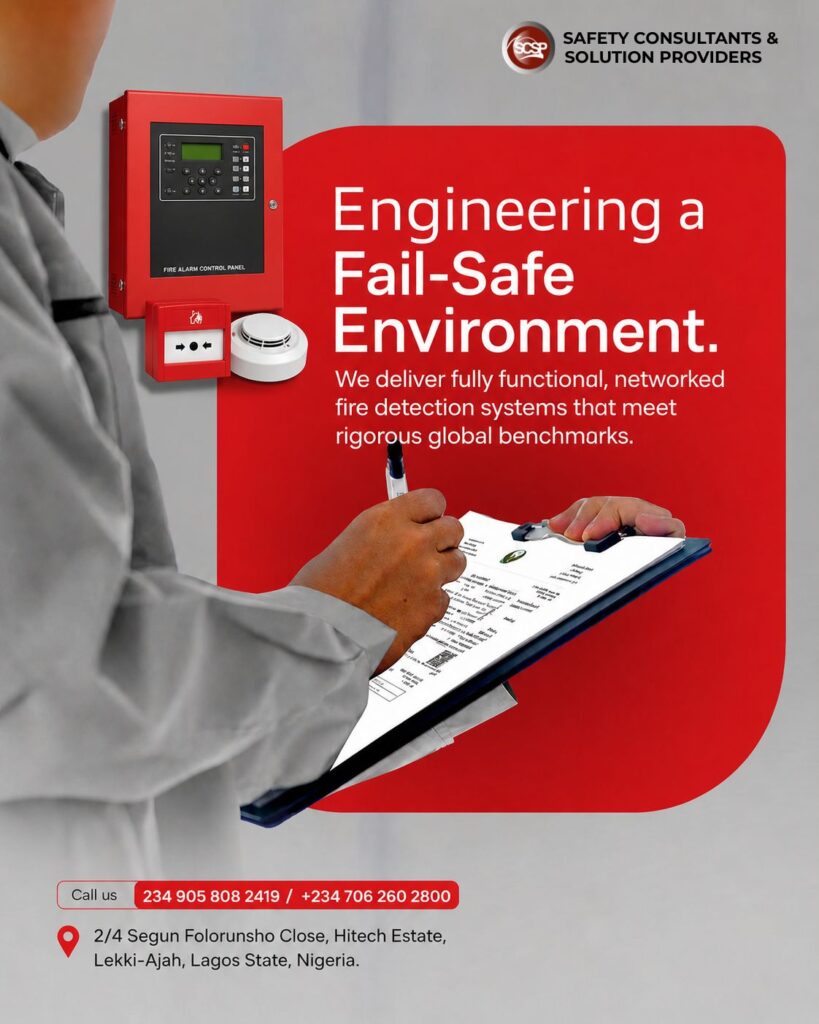
- Fire detection and alarm systems: many Nigerian commercial buildings still lack functional smoke detection or have systems that have not been maintained. Install and service them.
- Fire extinguishers: ABC dry chemical extinguishers are the standard baseline for offices and shops; warehouses and specialist facilities need types matched to their specific hazards. Extinguishers must be accessible, correctly placed, and regularly inspected to NIS 155:2010 requirements.
- Clear and unobstructed escape routes: blocked corridors are one of the most common fire safety failures found in Nigerian premises inspections. Exits must be signed, unobstructed, and open able without a key during occupancy hours.
- Emergency lighting: power loss is a routine occurrence in Nigeria; emergency lighting ensures occupants can reach exits safely when it happens during a fire.
- Regular electrical inspections: given that electrical faults are the leading cause of commercial fires locally, formal periodic inspection of wiring, distribution boards, and generator connections is essential and should not be deferred.
Steps 5 and 6: Recording your findings and building an emergency plan
What a compliant fire risk assessment record must contain
A written record is strongly expected by enforcement agencies and represents recognized best practice once the assessment is complete. The document must cover:
- Premises details
- Every hazard identified
- The people at risk
- Existing controls in place
- Gaps between what exists and what is required
- An action plan with named owners and target completion dates
- A scheduled review date
Nigeria-adapted templates based on the UK five-step format are widely available and can be assembled in a spreadsheet or word-processing document. The structure is less important than the completeness and honesty of what is recorded. For practical templates and commercial property checklists you can adapt, see a useful commercial property fire risk assessment guide and accompanying checklists.
For businesses applying for operating licences, seeking property insurance, or facing regulatory inspection, the assessment record needs to meet the standard expected by enforcement agencies. Having the assessment conducted or formally validated by a specialist firm ensures the documentation holds up under scrutiny. SCSP produces audit-ready compliance records for organizations across Nigeria, including manufacturing facilities, commercial towers, and public-sector buildings, covering the full scope from hazard identification to final documentation.
Building a workable emergency evacuation plan
The evacuation plan is a separate document, referenced within the assessment record. It must specify the evacuation route for each zone of the building, the location of the designated assembly point, fire warden roles and responsibilities by name or job title, and the procedures for assisting people who need help during evacuation. At a minimum, the plan must be documented, communicated to all staff, practiced through drills, and readily accessible throughout the building. A plan that exists only as a laminated poster on one wall is not an emergency plan; it is decoration. For practical guidance on organizing emergency response, including the mobilization of resources, consider our article on organization and deployment of emergency and salvage operations.
Steps 7 and 8: Training your team and running fire drills
What fire safety training must cover for your staff
Every member of staff needs to know how to raise the alarm, when and how to use a fire extinguisher, and the evacuation route from their work area to the assembly point. There is also a critical short list of what not to do: re-entering the building, using lifts, or stopping to collect personal belongings. Fire wardens need additional training covering how to conduct a sweep of their zone, manage an orderly evacuation, and account for all occupants at the assembly point. Training is not a one-time event; it must be given on induction and repeated whenever the layout, occupancy, or procedures change significantly.
How to run a drill that actually prepares people
An announced drill is useful for familiarizing staff with the procedure. An unannounced drill is better for testing how people actually respond under realistic conditions. After every drill, record the total evacuation time, any blockages or bottlenecks discovered, notable staff behavior, and whether all occupants reached the assembly point and were accounted for. That record feeds directly back into the assessment: if the drill exposes a problem, the assessment needs to be updated and an action assigned to fix it. For practical tips on conducting meaningful, realistic drills, see guidance on running successful fire drills.
When to review your assessment and what forces an immediate revisit
Nigerian statute does not prescribe a fixed review interval in explicit terms, but annual review is the accepted best-practice benchmark and aligns with NFPA guidance. Write the review date into the assessment document at the point of completion so it cannot be overlooked. An outdated assessment provides neither legal protection nor practical protection. For more on recommended review intervals, see expert guidance on how often a commercial fire risk assessment review should be carried out.
Certain events require an immediate, unscheduled review, do not wait for the annual cycle. These include:
- Changes to the building layout or escape routes
- Introduction of new processes, machinery, or hazardous materials
- A significant change in the number or type of occupants
- Any fire incident or near miss, however minor
- Changes to fire safety equipment
- The arrival of a worker requiring specific evacuation arrangements
- Any update to applicable fire safety law or official guidance
If any of these occur, treat the existing assessment as provisional and revisit it before normal operations continue.
Workplace fire safety checklist: quick items to verify before your next inspection
Use this checklist to confirm your baseline controls are in place. Tick each item or flag it for action:
- All electrical distribution boards inspected within the past 12 months
- Smoke detectors and alarm systems tested and serviced
- Fire extinguishers correctly positioned, accessible, and within inspection date
- All exit routes clear of obstructions, signed, and open able without a key
- Emergency lighting tested and functional
- Evacuation plan documented, communicated to staff, and posted in key areas
- Assembly point clearly identified and known to all occupants
- Fire warden roles assigned and trained
- Last fire drill completed within 12 months and findings recorded
- Assessment review date recorded and not overdue
For a focused commercial-buildings checklist you can use during walk-throughs, consult a practical fire risk assessment checklist for commercial buildings.
How do I know if I need a professional fire risk assessor for my business in Nigeria?
For straightforward premises, a single-floor office, a small retail shop, or a café, a competent business owner or safety officer can complete the assessment using a structured template. Where premises are larger, multi-storey, or involve hazardous materials, industrial processes, or high occupancy, a qualified fire risk assessor brings the technical knowledge and independent perspective that in-house assessments can miss. A specialist is also necessary when the assessment output is intended to satisfy a licencing authority, an insurer, or a formal regulatory audit.
Start the walk-through today
Asking “how do I conduct a fire risk assessment for my business in Nigeria?” is the right starting point, and the eight steps above give you a clear, actionable answer. Identify hazards, map people at risk, evaluate and prioritise risk, put controls in place, record findings, build an emergency plan, train your staff, and run drills that feed back into the record. Nigerian fire safety law and NFPA standards provide a clear framework, and the five core controls, detection and alarms, correct extinguishers, clear exits, emergency lighting, and electrical maintenance, resolve the majority of risk in commercial premises.
Businesses that lack the time, in-house expertise, or need third-party validation for licensing, insurance, or regulatory purposes can engage a specialist to conduct or review the assessment on their behalf. Safety Consultants & Solution Providers Limited (SCSP) offers this service across Nigeria, from retail premises and corporate offices to industrial facilities and public buildings, covering the full scope from hazard identification to audit-ready documentation.
The cost of a proper assessment is a fraction of what a preventable fire costs in lives, assets, and business continuity. Contact SCSP to book a walk-through of your premises or to have a qualified fire risk assessor guide you through the process.