
Fire kills. Across Nigeria, commercial buildings, markets, office towers, and residential blocks are lost to fire every year. Investigations and incident reports from the Federal Fire Service and NEMA consistently point to the same pattern: premises where fire safety obligations were misunderstood, partially addressed, or allowed to lapse. Fire safety compliance in Nigeria is not a single regulation you tick off once and forget. It is a layered obligation combining federal law, a national technical code, and state-level enforcement. Some building owners only discover how complex that obligation is when a fire officer arrives unannounced, or, worse, after an incident has already occurred.
This guide cuts through the confusion. By the time you finish reading, you will know exactly which regulations apply to your building, who enforces them, the step-by-step process for obtaining your Fire Safety Compliance Certificate, what auditors inspect during an on-site visit, and what to expect in terms of costs. Every section is practical. None of it is theoretical.
The legal framework: which regulations govern fire safety compliance in Nigeria
Nigeria’s fire safety regulatory structure is deliberately layered, not unified, and that distinction matters enormously. There is no single statute that covers every obligation. Three distinct pillars govern compliance, and understanding all three is what separates buildings that sail through certification from those that keep failing inspections.
The Fire Service Act and federal oversight
The Fire Service Act is the foundational federal instrument. It grants the fire service authority to inspect buildings, advise on prevention, and make regulations covering water supply, fire alarms, and building safety requirements. Contraventions carry legal consequences, including fines and imprisonment, so this is not soft guidance. The Act also empowers fire officers to enter premises for inspection purposes, which means the right to inspect does not require your invitation.
National Fire Safety Code 2013
The National Fire Safety Code 2013 sets the technical baseline every building must meet. It covers minimum requirements for automatic fire detection and alarm systems, smoke and heat detectors appropriate to the occupancy risk, audible alarms, rising mains in multi-storey buildings above specified heights, and alarm zoning by floor or area. It is worth noting that the practical effect of the Code depends on how individual states have adopted and implemented it, but where it applies, the standards are non-negotiable. If your building does not meet these technical minimums, no amount of paperwork will get you a certificate.
National Building Code and state-level requirements
The National Building Code adds structural compliance requirements: means of escape, travel distance limits, fire doors, protected lobbies, fireman access routes, and designated assembly areas. In Lagos State, the Lagos State Building Control Agency (LASBCA) adds another layer for any property going through development approval. LASBCA requires fire-rated doors (one-hour rating for public buildings, with external doors opening outward), protected escape routes, early warning systems, and fire safety certification available on demand. Lagos-based properties therefore face federal and state obligations simultaneously, and treating them as interchangeable is a costly mistake. For a deeper look at structural collapse risks and how to account for them in fire situations, see SCSP’s guidance on structural integrity considerations against collapse in case of fire.
Who enforces fire safety compliance and what happens when buildings fail
This is the section most building owners wish they had read before their first failed inspection. Enforcement in Nigeria is real and multi-agency, with inspections now drawing on multiple regulatory bodies operating in coordination.
Federal Fire Service: the national enforcement arm
The Federal Fire Service (FFS) operates under the Ministry of Interior. Its Investigation, Inspectorate and Enforcement division inspects public buildings, issues compliance notices, and holds authority over fire safety standards nationally. The FFS is the body that issues the Fire Safety Compliance Certificate for federal-level requirements and either conducts or validates fire safety audits as part of that process. When the FFS issues a compliance notice, addressing it is not optional.
State fire services, LASBCA, and multi-agency operations
State fire services enforce local fire safety regulations, including routine building inspections and permit-related checks. In Lagos, LASBCA coordinates building control approvals that incorporate a formal fire safety sign-off before development approval is granted. Enforcement operations frequently bring together SON, NSCDC, FRSC, and NEMA, particularly for fire extinguisher compliance and broader building safety checks. Assuming your premises will not be inspected is a risk that is harder to defend every year.
Penalties for non-compliance
The Fire Service Act lists specific offences: false alarms, interference with firefighting equipment, obstruction of a fire officer in the course of duty, and contravention of building fire regulations. Penalties under the Act range from fines to imprisonment of up to six months, depending on the offence. It is worth noting that the Act’s published fine amounts reflect older naira values, and state laws routinely impose stricter sanctions than the federal baseline. Beyond the legal exposure, non-compliance carries serious business consequences: potential loss of operating licence, difficulty renewing building permits, exclusion from government contracts, and civil liability exposure following a fire incident. The specific consequences depend on the applicable law and circumstances, but none of them are outcomes any responsible building owner should leave to chance.
How to obtain your Fire Safety Compliance Certificate: step by step
The certification process has a clear sequence. Skipping steps or submitting incomplete documentation is the single most common reason organisations miss their target certification date and incur repeat inspection costs.
Step 1: prepare your premises and gather your documents
Before a single form is submitted, your premises must already meet minimum physical requirements, because an on-site inspection follows application. The documents required for a Federal Fire Service application are:
- Completed application form
- Certificate of Occupancy or tenancy agreement
- Building plan approval
- Fire Safety Audit Report prepared by a competent assessor
- Floor plans and photographs of the premises, both internal and external
- Details of fire safety equipment installed on site
- Evacuation plan for fire emergencies
State fire service applications typically require a similar document set. The key document is the Fire Safety Audit Report: without it, your application will not progress. That report must be prepared by someone who understands what the inspecting officer will be looking for, not simply filled in as a formality.
Step 2: submit your application and pay the prescribed fee
Applications go through either the relevant FFS office or the state fire authority’s portal. For Lagos State, the process involves online registration, completion of a levy declaration, fee payment, and scheduling of the facility inspection through the portal. Published Lagos fees, which relate specifically to the Lagos tall-building and development compliance sequence, include a ₦15,000 processing fee at application stage and a ₦100,000 registration fee upon approval (verify current figures directly with LASBCA, as schedules are updated periodically). For buildings going through the FFS route, a compliance certificate invoice is issued and paid before the certificate is released. Requirements and fee levels vary by state and building type, so confirming the current schedule directly with the relevant office before submitting is always the right first step. For a practical external reference on the step-by-step process to obtain a fire compliance certificate, consult this essential guide to obtaining your fire compliance certificate.
Step 3: inspection, corrective action, and certificate issuance
After submission, fire officers schedule and conduct an on-site inspection of the premises. They will issue a report detailing any deficiencies and a compliance timeline for remediation. The certificate is only released once all recommendations have been addressed and confirmed. Addressing deficiencies superficially, or skipping the corrective action phase altogether, is the most common reason organisations find themselves back at the beginning of the process. Treat the inspection report as a work order, not a suggestion.
What fire safety auditors check: building your compliance readiness
A well-prepared building passes on the first inspection visit. An unprepared one cycles through expensive re-inspections and, in some cases, receives an enforcement notice that disrupts business operations. Here is what auditors are looking for.
Fire detection, suppression, and extinguisher certification
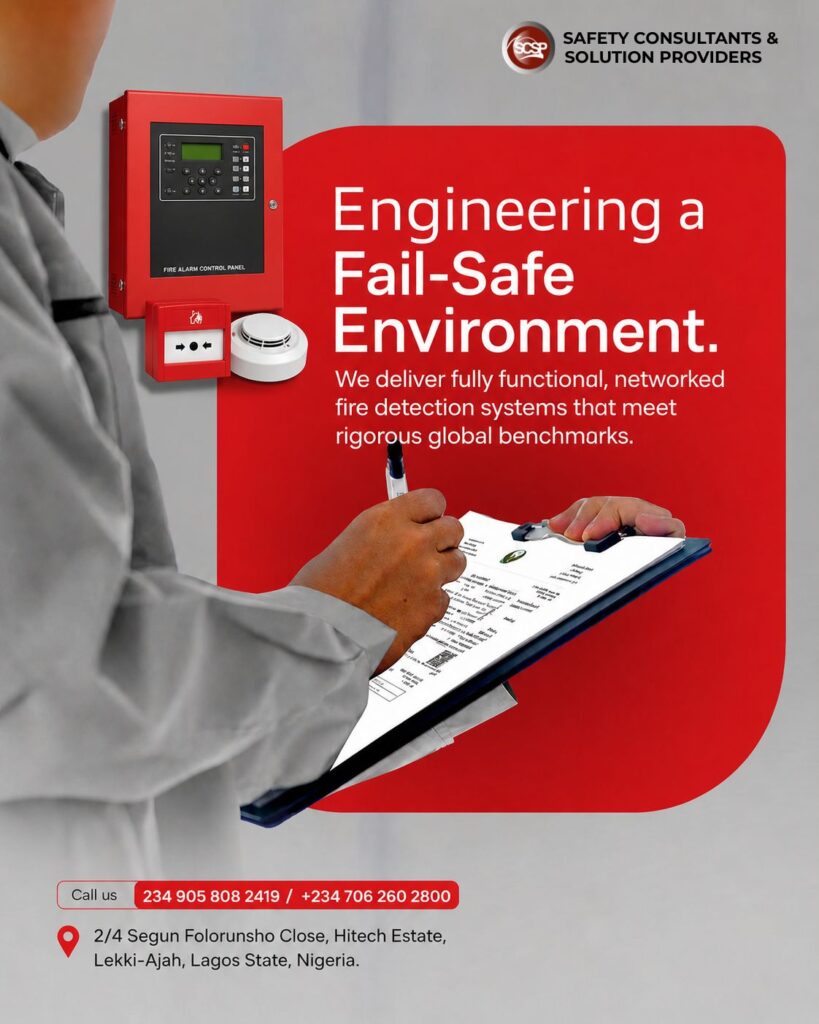
Auditors test alarm system functionality and verify zone coverage, inspect smoke and heat detector maintenance records, and check that the fire alarm panel is operational with zone information displayed. For extinguishers, they confirm the correct type and adequate number for the specific hazards present, proper mounting and unobstructed accessibility, pressure within specified limits, and up-to-date service records showing periodic external servicing. In Nigeria, extinguisher certification requires documented servicing, not just physical presence of the equipment. An extinguisher that has never been serviced is a compliance failure regardless of how new it looks. For guidance on extinguisher quantity and placement, some international resources provide useful reference points for planning and procurement decisions.
Escape routes, emergency lighting, and signage
Physical checks cover exits that are unlocked during occupancy and can be opened easily, clear directional and illuminated exit signage, emergency lighting that functions and has documented test records, and unobstructed travel routes from any point in the building to an assembly area. These are consistently among the most frequently failed items in Nigerian fire safety audits. Blocked corridors, locked emergency exits, and missing signage are findings that auditors record immediately, and they are entirely avoidable with routine checks.
Documentation, training records, and evacuation planning
Auditors do not just inspect hardware. They will request staff fire safety training records, evidence of fire warden designations, dated evacuation drill records, Personal Emergency Evacuation Plans (PEEPs) for any persons who may need assistance during an evacuation, and electrical safety inspection records. A well-documented management system carries significant weight in the final audit report. Buildings that have the physical systems in place but cannot produce the paperwork to prove they are managed and tested regularly do not achieve full compliance.
Working with a fire safety compliance partner in Nigeria
Knowing what is required and executing it correctly are two different things. The fragmented nature of Nigeria’s regulatory framework, spanning the Fire Service Act, the National Fire Safety Code, the National Building Code, LASBCA requirements, and state-level enforcement, means that a generic checklist is not enough. Organisations that attempt self-certification without specialist knowledge frequently miss jurisdiction-specific requirements, submit incomplete audit reports, or address physical deficiencies that are not the real gap. All of which delay certification and increase costs.
Safety Consultants & Solution Providers Limited (SCSP) is a multidisciplinary fire safety and HSE consultancy with extensive experience supporting Nigerian organisations across sectors, from commercial property developers and banks to manufacturing plants and government facilities. SCSP offers end-to-end compliance support across the full cycle: fire risk assessment and audit report preparation, specification and commissioning of fire detection and suppression systems, liaison with the Federal Fire Service and LASBCA, equipment compliance verification, evacuation planning, and staff fire safety training.
Rather than navigating a complicated multi-agency process on your own, working with an experienced compliance partner removes the guesswork and keeps your project on a clear path to certification.
Frequently asked questions about fire safety compliance in Nigeria
How long does it take to obtain a Fire Safety Compliance Certificate in Nigeria?
Timelines vary depending on the state, the completeness of your application, and how quickly deficiencies identified during inspection are resolved. In practice, organisations that submit complete documentation and address inspection findings promptly can expect the process to take several weeks. Incomplete submissions or unresolved deficiencies can extend this significantly.
Is the Fire Safety Compliance Certificate mandatory for all buildings?
Federal requirements apply to public buildings, and state-level obligations extend further depending on the jurisdiction. In Lagos, LASBCA requirements apply to buildings going through development approval. If you are unsure whether your building is covered, treat it as covered, the cost of a compliance audit is far lower than the cost of an enforcement notice.
What is the difference between a fire safety audit and a fire risk assessment?
A fire risk assessment identifies hazards, evaluates the likelihood and consequences of fire, and recommends control measures. A fire safety audit is a formal inspection against regulatory standards, typically required as part of the certification application. Both are necessary for full compliance, and the audit report must be prepared by a competent assessor.
Can a building fail a fire safety inspection more than once?
Yes. Buildings that address deficiencies superficially or incompletely will fail re-inspection. Each failed re-inspection adds cost and delay. The most efficient approach is to complete a thorough internal audit before the official inspection, resolve all gaps in advance, and submit only when you are confident the premises will pass.
Getting compliant and staying compliant
The picture that emerges from this guide is consistent. Nigeria’s fire safety obligations span federal law, a national technical code, and state-level requirements, no single document covers all of them. The certification process follows a sequential logic, and the organisations that get it right are the ones who complete each stage properly before moving to the next. What auditors inspect goes well beyond equipment: documentation, training records, and management systems carry equal weight alongside the hardware on the wall.
Fire safety compliance in Nigeria is achievable. The organisations that maintain it treat it as an ongoing system with regular reviews, not a one-off box-ticking exercise. Fires do not wait for the next inspection cycle, and neither should your compliance programme.
If your building or organisation needs expert guidance through the compliance process, from initial fire risk assessment to final certificate issuance, contact Safety Consultants & Solution Providers Limited (SCSP). The cost of getting compliance right the first time is always less than the cost of getting it wrong.