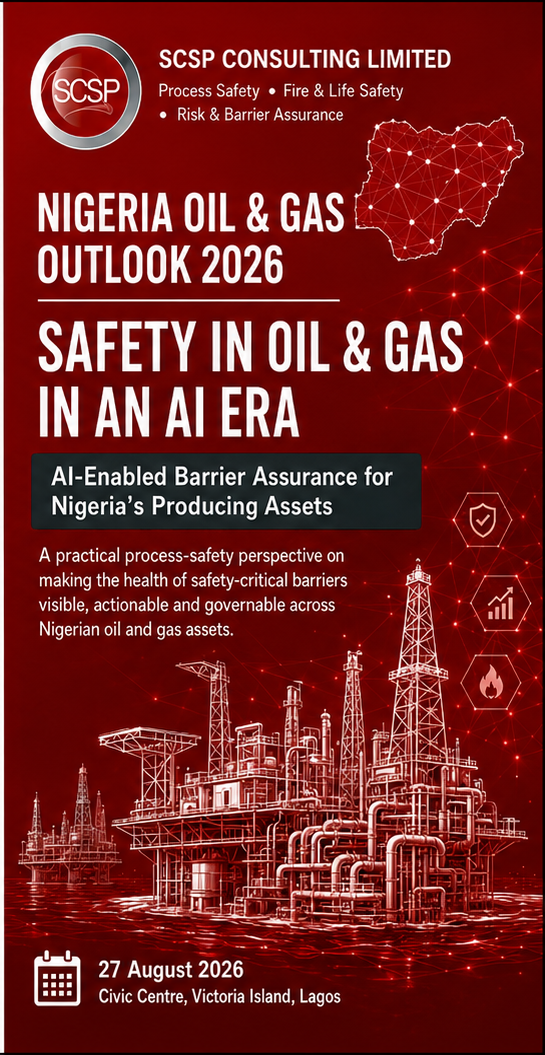


Nigeria’s next production gains will be carried by assets that can sustain containment, control, detection, mitigation and emergency response under higher utilisation. NUPRC’s July 2026 production update reinforces the link between production performance, asset reliability, operational resilience and timely intervention. That connection places process safety directly inside the performance conversation.
Artificial intelligence creates a practical opportunity to make the condition of safety-critical barriers visible with greater frequency. Process data, proof-test results, maintenance history, corrosion findings, alarm behaviour, detector diagnostics and operating-envelope excursions can be correlated around the hazard scenarios they protect against.
The highest-value AI use case in process safety is barrier visibility: knowing which safeguards are
healthy, which are degraded, and where cumulative degradation is increasing major-accident exposure.
SCSP technical position
Barrier Health Is Becoming an Executive Performance Variable
For a producing asset, the executive value of barrier assurance is practical. A production system remains dependable when the controls that prevent loss of containment, detect abnormal conditions, isolate hazardous inventory, mitigate fire and gas consequences and support emergency response remain available and effective.
Artificial intelligence can strengthen this operating discipline by connecting evidence of barrier condition that is already distributed across process, inspection, maintenance and safety systems. The resulting view is not simply an equipment dashboard; it is a scenario-based picture of the safeguards that stand between a credible hydrocarbon event and escalation.
Why This Is Particularly Relevant in Nigeria
Nigeria’s upstream landscape combines mature brownfield infrastructure, growing indigenous operatorship, renewed gas development and a national drive for higher production. NUPRC has documented the significant transfer of upstream assets to indigenous operators, while its safety framework places explicit responsibility on operators for safe systems, safety-critical equipment and technical safety studies.
These conditions create a specific assurance challenge. Many producing assets hold decades of inspection records, modifications, temporary repairs, overrides, alarm histories and maintenance data across different systems. The information exists; the decision value depends on connecting it to the current condition of the barriers controlling major accident hazards
1.67 mbpd – Combined crude + condensate production in July 2026 (NUPRC).
Asset transfers – Significant movement of upstream assets to indigenous operators (NUPRC).
Process Safety – Technical safety studies, safety-critical equipment and safety management systems sit within NUPRC HSEC oversight.
A Barrier-Based AI Model for Process Safety
IOGP’s Process Safety Fundamentals uses barrier health as a practical operating discipline: hardware and human barriers need to remain available, effective and understood. AI can strengthen this discipline when data is organized around the barrier rather than around the software system that generated it.
The control point in this model is engineering context. A high vibration value has limited safety meaning on its own. The meaning changes when the signal is tied to a compressor, its failure modes, the hydrocarbon inventory, the associated shutdown function, the fire-and-gas coverage, the inspection history and the major accident scenario.
What an AI-Enabled Barrier Assurance System Needs to Know
• Hazard scenario: the credible loss-of-containment or escalation event being controlled.
• Safety-Critical Element (SCE): the equipment, system or human barrier that prevents, detects, controls or mitigates the event.
• Performance standard: functionality, availability, reliability, survive-ability and response requirements for the SCE.
• Current condition: test status, impairment, bypass, degradation, maintenance state and relevant operating history.
• Operating envelope: the process conditions under which the barrier and the analytical model remain valid.
• Decision authority: the action the system may recommend, the competent person who accepts it, and the escalation path.
Four Nigerian Use Cases Worth Prioritizing
Primary Containment
Signals include UT thickness, corrosion rate, pressure and temperature history, leak detection and repair history. AI-enabled assurance can trend degradation against integrity operating windows and inspection history, supporting inspection priority, repair, re-rating, isolation or escalation decisions.
SIS / ESD:
Proof-test results, bypass and override status, demand history, diagnostic faults and valve-stroke data can be evaluated together to identify recurring faults and deteriorating barrier availability. The operating response may include restoration of integrity, removal of bypasses and re-prioritization of maintenance.
Fire & Gas Detection
Detector diagnostics, coverage studies, alarm history, obstruction and maintenance findings, and ventilation or meta-ocean information can be related to credible release scenarios. This supports decisions to repair, relocate, add coverage or revise the voting and maintenance strategy.
Firewater / Deluge / Isolation
Pump tests, ring-main pressure, valve status, impairments, deluge tests and isolation readiness can be correlated across interacting mitigation barriers to support restoration, sequencing of interventions and management of degraded operation.
The Assurance Boundary: Where AI Sits in the Protection Architecture
IEC 61511 remains the functional-safety backbone for Safety Instrumented Systems in the process industries. ISO/IEC TR 5469:2024 now addresses the relationship between AI and functional safety, including AI used inside a safety-related function, conventional safety functions protecting AI-controlled equipment, and AI used during development of safety-related functions.
For near-term oil and gas deployment, a clear engineering boundary is essential. AI used for diagnostics, anomaly detection, maintenance prioritization and barrier-health interpretation can sit in an advisory layer. Any proposal to credit AI with independent risk reduction in LOPA, SIL verification or an automatic safety function requires a formal functional-safety justification, defined performance requirements, verification evidence and lifecycle governance.
AI can inform the condition of an Independent Protection Layer without automatically becoming an
Independent Protection Layer. Credited risk reduction requires evidence.
Functional-safety principle
Data Quality Becomes Part of Engineering Assurance
Brownfield AI programmes should begin with data provenance and configuration control. P&IDs, equipment registers, SCE registers, cause-and-effect charts, detector layouts, inspection records and maintenance histories need to reflect the physical plant. An analytical model built on outdated tag relationships or unresolved MOC changes can produce a technically polished output with weak engineering validity. A practical readiness review therefore tests traceability from each AI input back to the current asset configuration and the hazard scenario it supports. This creates an auditable chain from field signal to management decision.
From Process-Safety Indicators to Current Risk Exposure
API RP 754 provides a structured approach to process-safety performance indicators, including leading indicators that reveal weaknesses in key safety systems. Its Fourth Edition was issued in August 2026. AI extends the analytical reach of these indicators by examining combinations and sequences that are difficult to interpret through monthly reporting alone.
For a Nigerian producing asset, the executive risk view can combine safety-critical maintenance backlog, SIS proof-test performance, bypassed trips, integrity anomalies, alarm floods, fire-and-gas impairments, operating-envelope exceedances, overdue HAZOP actions and MOC status around the same major accident scenario.
The result is a scenario-based picture of current exposure. Three degraded controls tied to the same hydrocarbon-release scenario demand a different response from three unrelated maintenance items distributed across the facility.
Alignment with Nigeria’s Regulatory Safety Architecture
The Nigerian Upstream Petroleum Safety Regulations 2024 establish the legal safety framework for upstream petroleum operations. NUPRC’s Process Safety function explicitly covers technical safety studies, safety-critical equipment and safety-management systems. The Commission’s production-facility guidelines also require PSUA/PSSR activities, functional testing, Operations Safety Case readiness, competent personnel, procedures and systems before hydrocarbon introduction.
These requirements provide a practical governance home for AI-enabled barrier assurance. The technology should enter through established engineering processes: hazard identification, SCE definition, performance standards, technical specification, verification, validation, Management of Change, competence, operating procedures, performance monitoring and periodic revalidation.
A Practical Implementation Pathway for Nigerian Operators
1. Establish the scenario-barrier baseline – Consolidate HAZOP/HAZID, bow-tie, safety case and SCE registers into a single major-accident scenario and barrier structure.
2. Verify SCE performance standards – Define the functionality, availability, reliability, survivability and
assurance activities expected from each critical barrier.
3. Map the data to the barrier – Identify the process, maintenance, inspection, alarm, test and impairment data that evidences actual barrier condition.
4. Classify AI use-case criticality – Separate advisory analytics, operational decision support and any proposed safety-related functionality. Apply the assurance depth appropriate to consequence.
5. Build the barrier-health view – Use rules, analytics and machine learning to identify degradation patterns, recurring faults and cumulative impairments around each scenario.
For Nigeria, AI readiness in process safety begins with a verified barrier model of the real asset. The analytics layer becomes valuable when it can trace every conclusion back to equipment, scenario, performance standard and evidence.
SCSP – NOGO 2026
The Commercial Value Is Operational
Barrier assurance sits at the intersection of safety, reliability and capital allocation. Earlier recognition of degradation improves inspection priority, protects production uptime, reduces avoidable emergency work, supports safer deferment decisions and gives management a clearer basis for intervention. This is directly relevant to operators managing mature assets, recently transferred portfolios and facilities moving toward higher utilization.
Nigeria’s production ambition therefore has a process-safety data requirement: management must be able to see the condition of the controls that make production sustainable.
SCSP Perspective: An AI-Ready Barrier Assurance Baseline
SCSP’s public process and technical safety capability covers HAZOP, HAZID, SIL, LOPA, QRA, FERA, bow-tie analysis, Safety-Critical Elements and performance standards. These disciplines provide the engineering structure required before an operator can meaningfully automate barrier-health interpretation.
For operators exploring AI in safety-critical environments, a focused first engagement can establish the barrier architecture, verify data readiness, classify proposed AI use cases and define the executive risk view before technology selection or integration.
EXECUTIVE DISCUSSION: Can your leadership team see which major-accident barriers are degraded today – and which intervention reduces the most risk?
SCSP Consulting Limited | Process Safety • Fire & Life Safety • Risk & Barrier Assurance /www.scspng.com
Technical Reference Base
1. Nigeria Oil & Gas Outlook 2026 (Eventhive). 27 August 2026, Civic Centre, Victoria Island, Lagos; event audience and 2026 content tracks.
2. NUPRC – Nigeria Meets OPEC Quota for Third Consecutive Month (12 Aug. 2026). July 2026 production: 1.505 mbpd crude + 0.17 mbpd condensate; emphasis on asset reliability and operational intervention.
3. NUPRC – Upstream Petroleum Safety Regulations 2024. Legal framework for safety in upstream petroleum operations.
4. NUPRC – Health, Safety, Environment & Community / Process Safety. Process Safety mandate covering technical safety studies, safety-critical equipment and safety management systems.
5. NUPRC – Guidelines for Design, Construction and Operation of Oil & Gas Production Facilities in Nigeria, Version 5. PSUA/PSSR, functional testing, Operations Safety Case readiness and safe start-up requirements.
6. IOGP Report 638 – Process Safety Fundamentals. Barrier health and sustaining barriers in operational process safety.
7. IEC 61511 – Functional Safety: SIS for the Process Industry Sector. Lifecycle requirements for safety instrumented systems.
8. ISO/IEC TR 5469:2024 – Artificial Intelligence: Functional Safety and AI Systems. Relationship between AI and safety-related functions.
9. API RP 754, Fourth Edition (2026). Process safety performance indicators and leading indicators.
10. DNV-RP-0671 – Assurance of AI-enabled systems. Lifecycle assurance framework for industrial AI-enabled systems.
11. SCSP – Process Safety, Fire Safety Engineering & Loss Prevention. SCSP public description of process safety, fire safety and loss-prevention practice.
12. SCSP – Our Team. Public leadership profile of Antonia Beri, Technical Director.