

Environmental, Social and Governance performance is moving deeper into the operational and financial architecture of organisations. Energy consumption, greenhouse-gas emissions, water availability, material intensity, climate resilience, waste, biodiversity, worker conditions and community impact increasingly influence investment decisions, project design and corporate reporting.
The next question is practical: how should organisations engineer better ESG performance into the assets and systems that create those impacts?
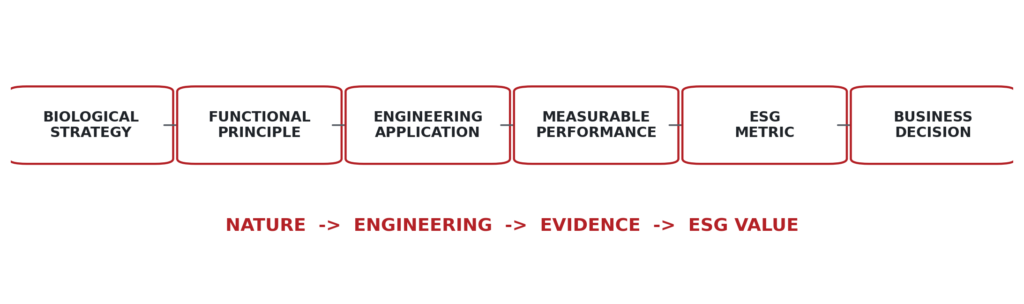
Biomimicry becomes valuable to ESG when a biological strategy is translated into an engineering principle, a measurable performance outcome and evidence that can support management decisions and disclosure.
ESG standards provide a reporting architecture. Biomimicry can help organisations create the underlying asset performance worth reporting.
ESG Is Moving From Reporting to Performance
For many organisations, the first phase of ESG centred on policies, commitments, sustainability reports and disclosure. The performance phase is more demanding because commitments eventually have to alter the physical systems that consume energy, use water, generate waste, expose communities to climate risks and determine the reliability of operations.
A company targeting lower operational carbon must eventually change how its buildings, utilities or processes consume energy. A manufacturer targeting lower water intensity must redesign process water, cooling, recovery or reuse. A developer addressing climate resilience must determine how a site responds to heat, rainfall, flooding and power interruption. An operator pursuing circularity must rethink how materials enter, remain within and leave the production system.
These are engineering questions. They translate ESG ambition into physical performance.
Nigeria is also moving into a more structured sustainability-disclosure environment. The Financial Reporting Council of Nigeria released an amended adoption roadmap and Sustainability Reporting Guideline 1 in 2026. The roadmap identifies a voluntary-adoption phase through accounting periods ending on or before 31 December 2027, with mandatory adoption for public-interest entities from accounting periods beginning on or after 1 January 2028 and for SMEs from 1 January 2030. [1]
IFRS S1 and IFRS S2 organise sustainability-related financial disclosure around governance, strategy, risk management, and metrics and targets. IFRS S1 is designed to surface sustainability-related risks and opportunities that could reasonably affect an entity's prospects, including cash flows, access to finance or cost of capital. [2]
SCSP technical interpretation: the quality of future ESG disclosure will increasingly depend on the quality of the operating systems and data beneath it.
Meters, asset registers, water balances, material flows, emissions inventories, resilience studies, maintenance records and operating interruptions will determine whether ESG claims can be linked to evidence.
What Biomimicry Actually Means
Biomimicry studies the strategies used by living systems to solve functional problems and translates those strategies into human design. The Biomimicry Institute describes the practice as learning from nature's forms, processes and ecosystems to address design challenges. [3]
The distinction between copying a natural appearance and understanding a biological strategy is essential. A building decorated with leaf patterns has little engineering significance. A façade developed after studying how biological surfaces regulate heat, water or contamination addresses a functional requirement.
The useful engineering question is: What does nature do under similar constraints, and what principle allows it to work?
Living systems operate with finite energy and materials. They experience disturbance, distribute resources through networks, adapt to changing conditions and retain value through cycles. These constraints are familiar to organisations pursuing resource efficiency, resilience and circularity.
Nature Optimises Function Before It Adds Resources
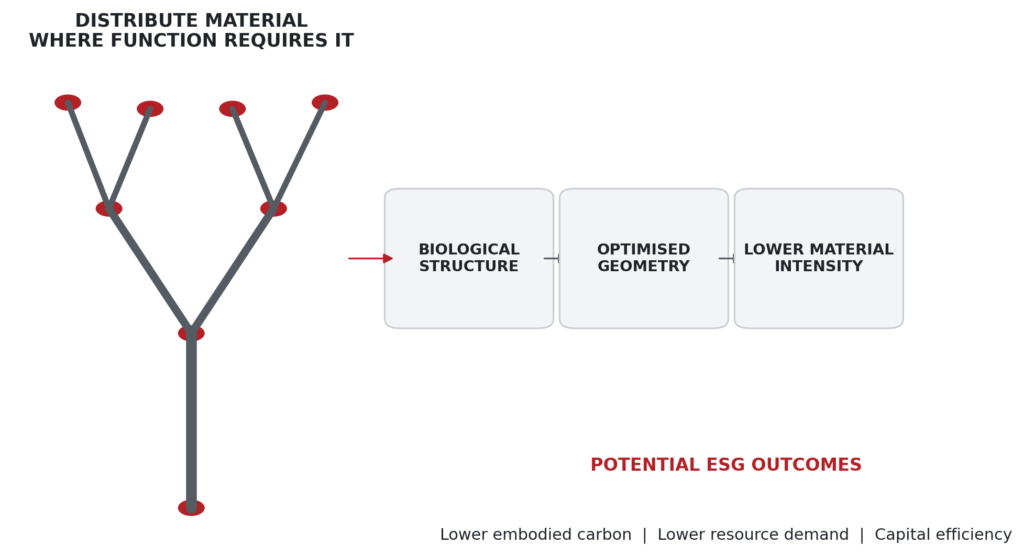
One of the strongest lessons from biological systems is resource efficiency. Bone does not have uniform density throughout the body. Trees distribute structural material according to load and growth. Honeycomb geometries achieve stiffness with relatively little material. The transferable principle is that geometry and material distribution can create performance before additional mass is introduced.
Engineering already applies similar logic through topology optimisation, lightweight structures, lattice systems and material-efficient design. The ESG opportunity is to make the resource consequence explicit.
• Lower structural material demand where analysis supports it.
• Reduced embodied carbon associated with materials and transport.
• Lower fabrication and handling requirements in selected applications.
• Improved material productivity over the functional output of the asset.
The useful metric is not simply whether a project uses a material marketed as sustainable. The useful metrics include material intensity per unit of output, embodied carbon, design life and replacement frequency.
Buildings Can Learn How Nature Manages Heat
Thermal performance is a significant design issue in Nigeria's hot climate. Cooling demand interacts directly with electricity consumption, standby generation, fuel use, operating expenditure and system reliability. A building with high cooling demand can therefore create environmental and business exposure at the same time.
Biological systems regulate temperature through combinations of geometry, controlled airflow, surface characteristics, thermal mass, evaporation and behavioural adaptation. Termite colonies are frequently studied for their ability to regulate internal nest conditions through structure and airflow. The transferable engineering principle is passive regulation of heat and air movement, rather than reproduction of the biological form itself.
Applications in buildings can include orientation, solar shading, façade geometry, natural and mixed-mode ventilation, stack-effect ventilation, thermal mass and adaptive envelope strategies.
For developers, the timing of the decision matters. Passive thermal strategies are most effective when considered during concept and architectural development because they affect form, orientation, façade and services loads. Introducing the same objective after major procurement shifts the problem into retrofit.
The potential ESG consequences include lower energy intensity, reduced associated emissions, improved thermal comfort and lower dependence on mechanical systems. The business consequences include operating cost, generator runtime, equipment capacity and lifecycle replacement demand.
Biomimicry Can Change How Assets Manage Water
Water presents both scarcity and excess risk. A facility may depend on boreholes, tankers or treated water for normal operations and still experience stormwater or flood exposure during intense rainfall. These conditions require engineering decisions across supply security, drainage, storage, reuse and resilience.
Living systems manage water at multiple scales. Leaves collect and channel water. Soils and root networks slow and redistribute rainfall. Wetlands retain and filter water. Mangrove systems dissipate hydraulic energy and tolerate dynamic coastal conditions through distributed structure.
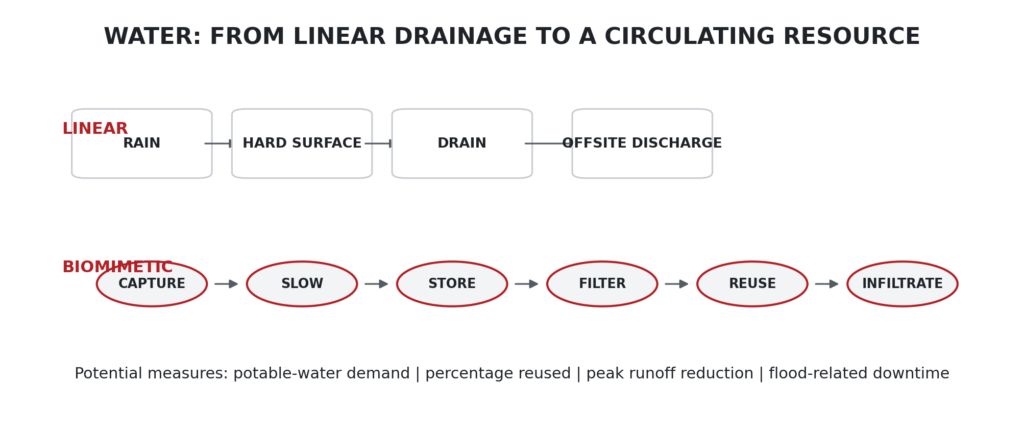
The transferable principle is to capture, slow, store, filter and reuse water before treating it as waste.
• Rainwater harvesting for suitable non-potable uses.
• Distributed stormwater detention and retention.
• Permeable landscape systems where geotechnical conditions support infiltration.
• Constructed wetlands and nature-based polishing systems.
• Site grading and landscape design that reduce peak runoff.
• Water-reuse loops for suitable industrial or facility applications.
The design outcomes can be measured through potable-water demand, percentage of water reused, stormwater retained onsite, peak runoff reduction, flood-related downtime and cost of external water supply.
About SCSP Consulting
SCSP Consulting Limited provides specialist environmental, safety, sustainability and risk-engineering services supporting the design, construction, operation and management of complex assets.
Safety • Compliance • Sustainability • Performance
www.scspng.com | info@scspng.com
Technical References and Nigerian Regulatory Context
[1] Financial Reporting Council of Nigeria - Roadmap Report for the Adoption of IFRS Sustainability Disclosure Standards in Nigeria (Amended 2026).FRC amended roadmap.
[2] IFRS Foundation - IFRS S1 General Requirements for Disclosure of Sustainability-related Financial Information and IFRS sustainability knowledge resources.IFRS S1
[3] Biomimicry Institute - Biomimicry Toolbox, Introduction.Biomimicry Toolbox.
[4] Securities and Exchange Commission Nigeria - Sustainable Financial Principles / sustainability reporting resources for the Nigerian capital market.SEC sustainability resources.
Regulatory note: the IFRS Sustainability Disclosure Standards and Nigerian adoption roadmap establish disclosure and adoption requirements. The biomimicry applications, engineering chains and asset examples in this article are SCSP technical interpretation intended to translate sustainability objectives into engineering and operating decisions.
Website Publishing Notes
Recommended Social / LinkedIn Teaser
What if ESG began with an engineering question rather than a reporting question? Nature already operates within constraints of energy, water and materials. It develops resilient structures, cycles resources and adapts to changing conditions. Biomimicry provides a method for studying those strategies and translating them into measurable asset performance.
Our latest SCSP insight examines how biomimicry can influence the next phase of ESG across buildings, infrastructure and industrial assets in Nigeria.
Recommended Graphic Set
• From Nature to ESG Performance
• Nature's Resource-Efficiency Principle
• Water: From Linear Drainage to a Circulating Resource
• Linear Business vs Ecosystem Business
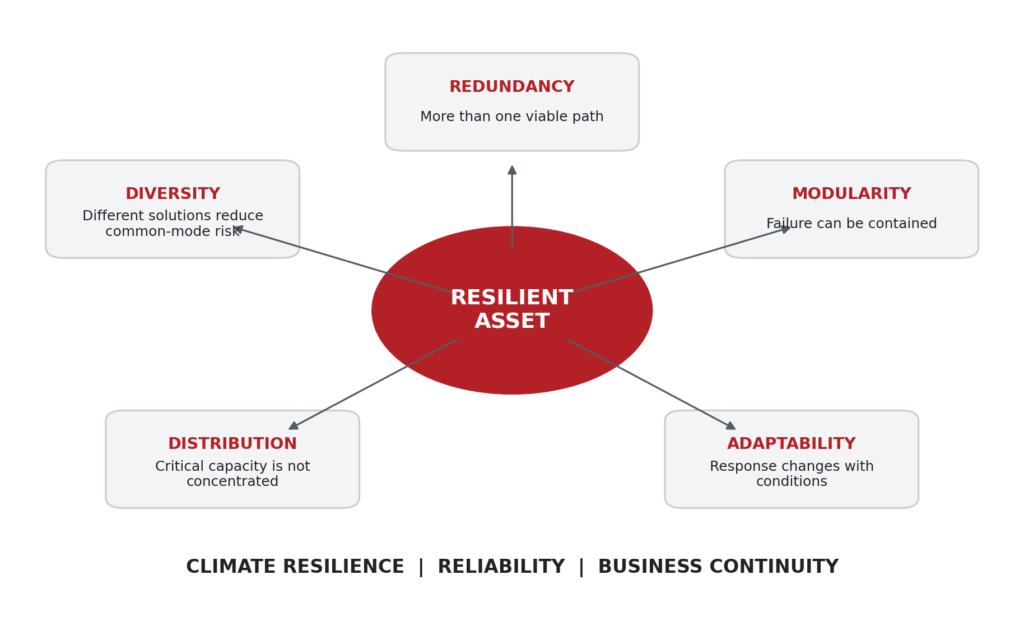
• Nature's Resilience Principles
• The ESG Traceability Chain
• ESG From Reporting Back to Engineering