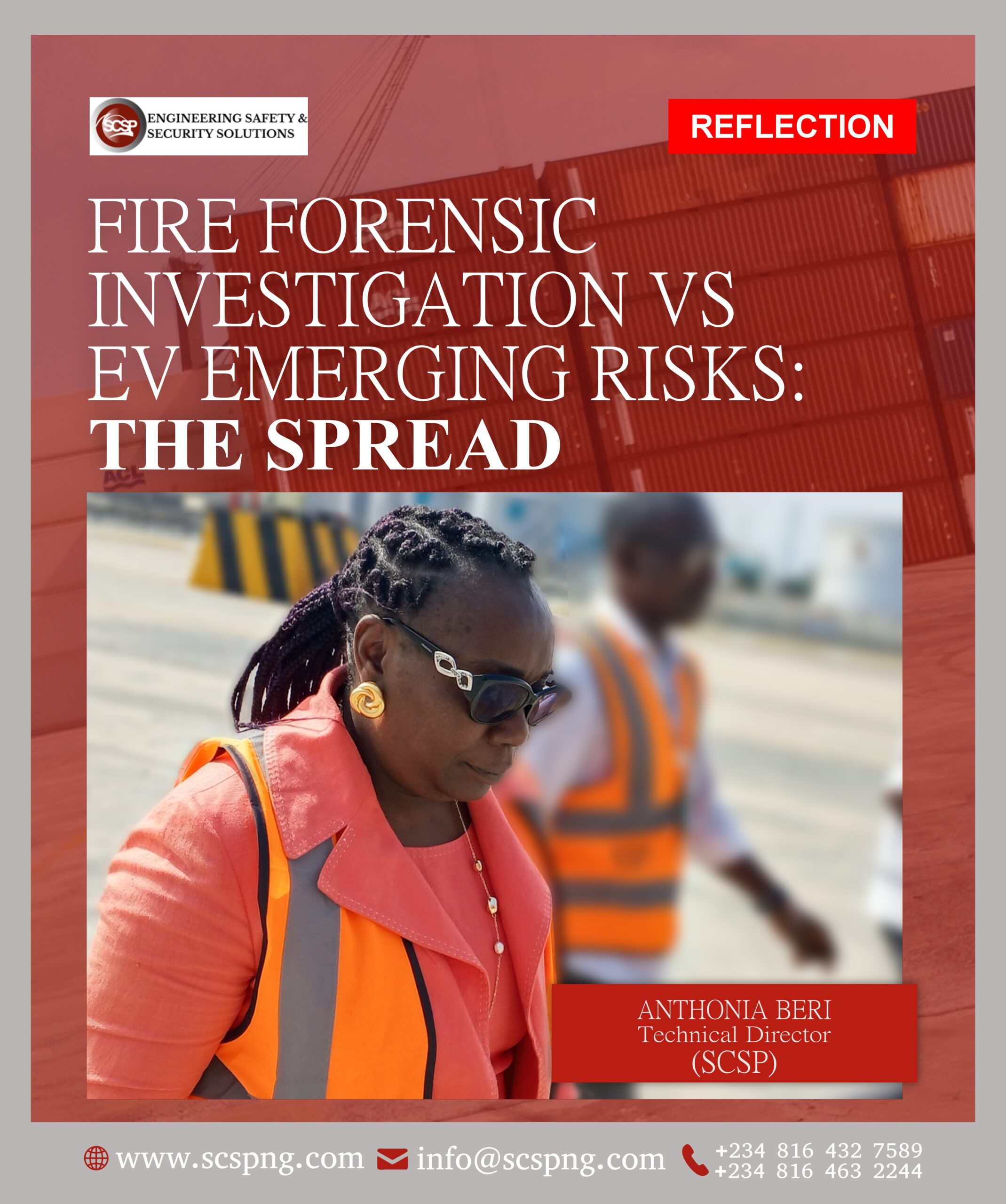


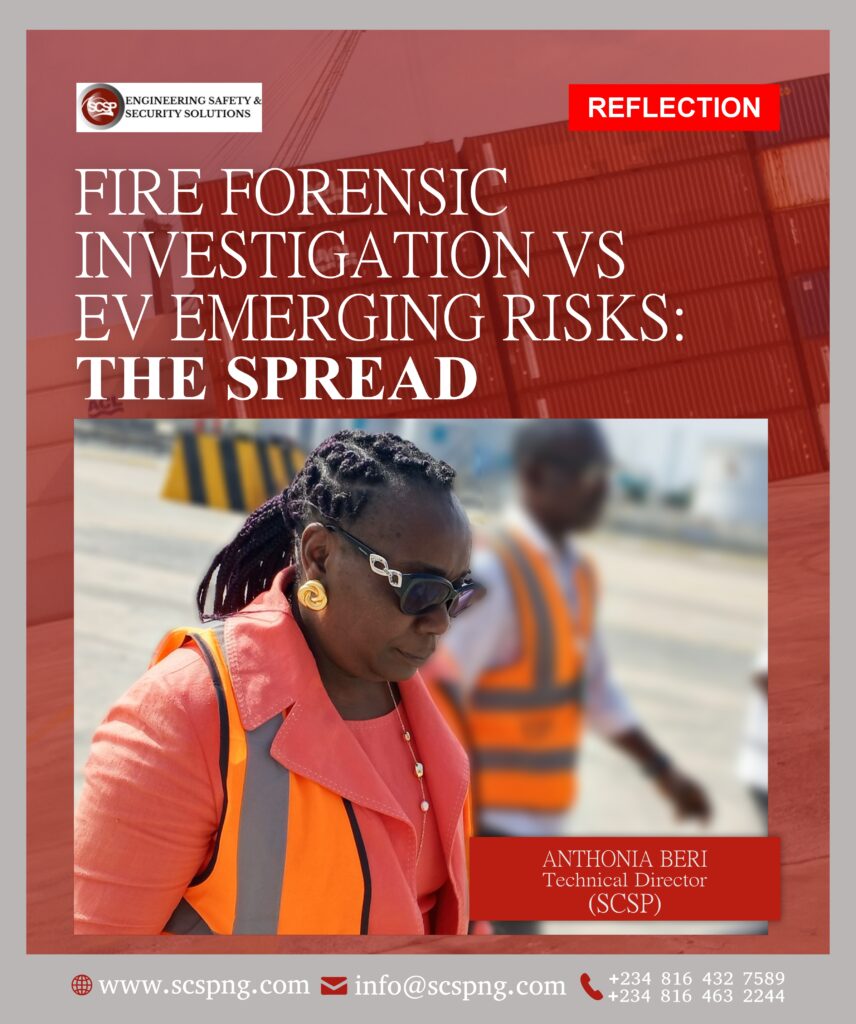
The conclusion of a recent forensic fire investigation involving a vehicle fire onboard a vessel en route to Lagos provides an important opportunity to look beyond the immediate incident and consider a much broader question: Are our fire-safety and fire-investigation capabilities evolving quickly enough to address the risks emerging from the transformation of transportation?
Forensic fire investigation is not simply about determining where a fire started or what ignited it. Its real value lies in understanding how the event developed, why it escalated or did not escalate and what lessons can prevent recurrence and protect life.
Learning Beyond the Point of Ignition
Our just-concluded investigation provided an opportunity to examine the fire from a holistic perspective: the vehicle involved, the surrounding environment, the potential for fire spread, available controls, emergency response and the consequences of escalation.
This is particularly important in the marine transportation environment, where a vehicle fire can quickly become a life-safety and asset-protection challenge.
On a vessel carrying multiple vehicles, the question is not only:
“What caused this vehicle to catch fire?”
It is also:
“What happens when one vehicle becomes a source of ignition in a confined or interconnected transportation environment?”
Could the fire propagate to adjacent vehicles?
Could smoke compromise evacuation?
Are detection and firefighting arrangements adequate?
Can responders safely approach the incident?
What happens if the vehicle involved has a high-energy battery system?
These are increasingly important questions.
The Emerging EV Challenge
The rapid adoption of electric vehicles is changing the risk landscape of transportation. Electric vehicles introduce high-energy lithium-ion battery systems and associated failure modes that require specialist understanding. Events involving battery systems can present challenges related to thermal runaway, heat release, fire propagation and potential re-ignition.
The issue becomes even more significant when EVs are transported in large numbers. A vessel carrying hundreds or potentially thousands of vehicles presents a very different risk environment from an isolated vehicle fire on a roadway. This is where the concept of mass EV risk deserves serious attention. The transportation industry must begin asking whether existing assumptions around:
- vehicle stowage
- fire detection
- fire suppression
- firefighting tactics
- ventilation and smoke management
- emergency response
- crew competence and training
- isolation and separation
- evacuation and life safety remain adequate for an increasingly electrified vehicle fleet.
Why Specialist Forensic Skills Matter
The emerging risk also has implications for forensic fire investigation itself. Investigating a conventional vehicle fire and investigating an incident involving an advanced battery-electric vehicle may require different technical considerations.
The investigator may need to understand not only traditional fire dynamics, electrical systems and ignition sources, but also battery architecture, energy storage systems, thermal behaviour, vehicle charging systems and the interaction between the vehicle and its operating environment. This calls for multidisciplinary expertise.
Fire investigation + electrical engineering + vehicle technology + marine safety + fire dynamics + loss prevention.
No single discipline should operate in isolation when the consequences of a fire can involve hundreds of lives and significant economic assets.
From Investigation to Prevention
The greatest value of forensic investigation is not the report that closes an incident. It is the learning that changes future design, operations and emergency preparedness.
Every investigation should therefore ask:
- What failed?
- What worked?
- What prevented escalation?
- What could have made the outcome worse?
- And, most importantly, what must change before the next incident?
This is where forensic investigation becomes a powerful tool for loss prevention and safety engineering. The lessons should feed back into vessel design, vehicle-carrier operations, stowage arrangements, detection and suppression strategies, emergency procedures, crew training, regulatory requirements and risk assessments.
Protecting Lives in a Changing Transportation Landscape
As Africa’s transportation systems modernize and EV adoption accelerates, we cannot wait for incidents to expose gaps in our preparedness.
We need to anticipate the risk, understand the technology and build the appropriate safety capability before the risk becomes a major loss event.
The just-concluded investigation is therefore not simply about one incident. It is a reminder that the transportation sector is changing and our approach to fire safety, emergency response and forensic investigation must change with it.
Every investigation should not only explain the past. It should make the next incident less likely and less catastrophic.
The future of transportation requires the future of fire safety
#ForensicFireInvestigation #ElectricVehicleSafety #EVFireSafety #MarineFireSafety #FireEngineering #FireInvestigation #LossPrevention #EmergingRisks #LifeSafety #MaritimeSafety #TransportationSafety #ProcessSafety #SCSP