

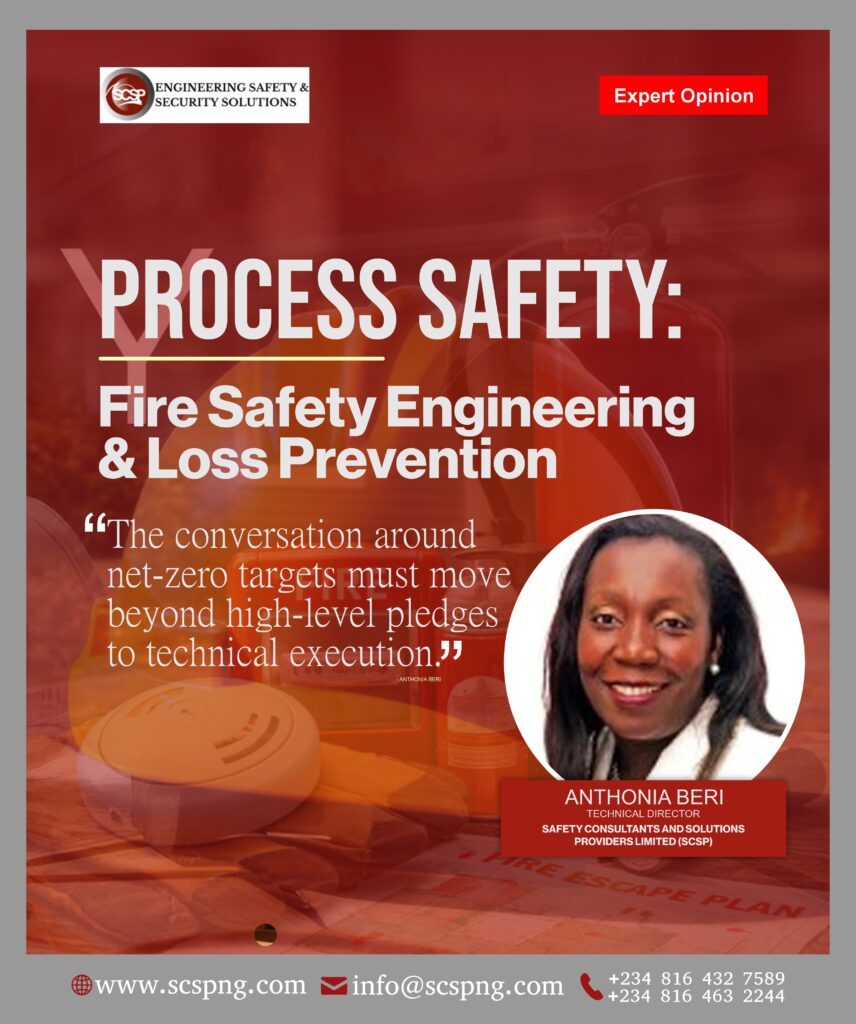
Process Safety prevents major process accidents. Fire Safety Engineering prevents and mitigates fire loss. Loss Prevention brings these disciplines together around a broader objective: protecting people, assets, operations and business value. They overlap heavily, but they are not synonyms.
Understanding this distinction is important for organisations seeking to move beyond compliance toward a more integrated approach to risk, asset protection and business resilience.
The Strategic Distinction
For SCSP, the distinction can be framed through the questions each discipline asks:
Process Safety Asks:
“How do we prevent a major accident arising from our process?”
Fire Safety Engineering Asks:
“How do we prevent, control and mitigate fire and its consequences?”
Loss Prevention Asks:
“What loss are we exposed to, what barriers protect us, and what must we do to prevent or minimise that loss?”
That last question is what makes Loss Prevention broader than any single technical discipline. It sits at the strategic intersection of:
Engineering → Risk → Asset Protection → Underwriting → Business Resilience
Where Fire Safety Engineering Fits
Fire Safety Engineering should not be reduced to firefighting equipment or emergency response.
It is an engineering discipline concerned with the prevention, detection, control, mitigation and consequence management of fire.
Its tools and strategies may include:
- Fire hazard identification and risk assessment
- Fire and explosion consequence assessment
- Detection and alarm systems
- Suppression systems
- Passive fire protection
- Compartmentation
- Smoke control
- Means of escape and life safety
- Structural fire protection
- Emergency response
- Fire modelling and performance-based design
- Business continuity and asset protection
Fire Safety Engineering therefore addresses much more than what happens after a fire starts. It considers how fire can be prevented, how its development can be controlled, how people and assets can be protected, and how the consequences can be limited when prevention barriers fail.
The Strategic Shift
The question should therefore move beyond:
“Are we compliant?”
Compliance remains important but compliance should be regarded as a baseline rather than the final objective.
The more strategic questions are:
“What are we exposed to?”
“What barriers protect us?”
“Are those barriers adequate and effective?”
“What is the residual risk after risk reduction?”
“What happens if those barriers fail?”
And ultimately:
“What value are we protecting, and what loss are we unwilling to accept?”
That is the essence of Loss Prevention.